Digital Microscope for Electronics Repair UK: What Your Bench Actually Needs
Short answer: for electronics repair, buy working distance, a rigid stand and a low-lag image before you buy magnification. If a soldering iron, hot-air nozzle and tweezers cannot all reach the board while you watch a feed that keeps up with your hands, the zoom number on the box is irrelevant.
The three specs that earn their keep
1. Working distance you can work under
If you spend your day on phone logic boards, charging ports and FPC connectors, the lens needs to sit high enough that an iron tip or hot-air nozzle fits underneath at the magnification you solder at. A scope that only achieves its advertised detail with the lens almost touching the board is an inspection tool, not a repair tool. We cover how to set clearance per task in the working distance for micro soldering guide.
2. A feed that keeps up with your hands
Anyone who has re-worked a USB-C port with a laggy USB camera knows the moment: the tip is already on the pad but the screen is still catching up, and you very nearly drag a pad off with it. Hand-eye synchronisation is the whole game in micro-soldering. A built-in screen or a direct HDMI feed to a monitor avoids the computer processing hop that causes most of the delay — the full comparison is in our HDMI vs USB microscope guide.
3. A stand that does not wobble
At soldering magnifications, a flexing column turns every bench knock into an earthquake on screen. Look for a heavy base, minimal play in the column, and fine height adjustment you can operate with one hand while the other holds tweezers.
One scope, two very different jobs
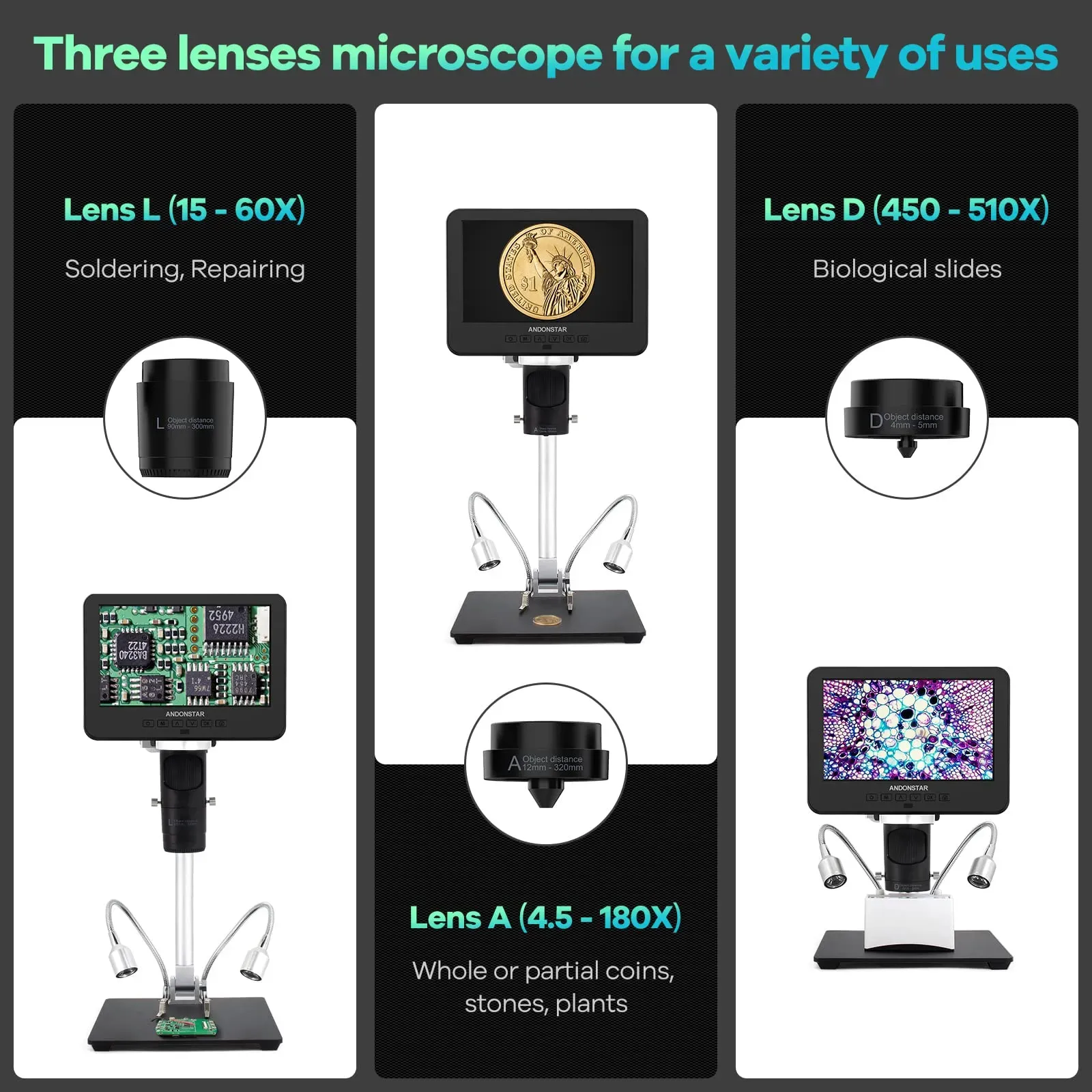
Board-level work alternates between two modes: surveying a whole board for burnt components, corrosion or missing passives, and then working tight on one joint. A single fixed lens forces you to compromise on both. This is why a multi-lens system earns its place: the Andonstar AD246S-M ships with three interchangeable lenses so wide survey and close solder work each get appropriate optics — one device covering what would otherwise tempt you into buying a second scope.
Display choices for a repair bench
A 7-inch integrated screen keeps the setup self-contained and means the scope works without a computer on the bench. HDMI output adds the option of a larger monitor mounted at eye level — useful when you want the image bigger, or when someone else needs to watch a repair without leaning over your shoulder. USB connectivity on the AD246S-M covers file transfer for saved captures, so recorded evidence of a repair leaves the device easily.
Setting it up so it stays used
- Mount the screen (or external monitor) so the top edge sits at or just below eye level — your neck will thank you by Friday.
- Dial LED brightness down for shiny HASL boards; glare hides solder bridges and hairline cracks.
- Fix the column height per lens and mark it, so switching between survey and joint work does not mean refocusing from scratch every time.
- Solder fume is not optional admin: HSE publishes guidance on rosin-based solder flux fume — use extraction for regular work.
Where a digital scope is the wrong answer
Honesty about the limits: heavy BGA rework under high magnification still favours a stereo optical microscope for true depth perception, and certified measurement work needs industrial instruments. A digital bench scope covers the broad middle of repair work — inspection, micro-soldering, documentation — which for most UK benches is the entire job list.
Frequently asked questions
Do digital microscopes lag too much for live soldering?
Not if the feed path is right. Delay creeps in when the image goes through a computer — sensor to USB to driver to application — and it varies with what else the PC is doing. Working from the integrated screen or a direct HDMI connection keeps the picture in step with your hands for pad-level work.
Can I fit a hot-air nozzle under a digital microscope?
With the right lens and column height, yes — that is exactly what to verify before buying. Check the working distance at your actual soldering magnification, not the maximum figure quoted at minimum zoom. Interchangeable lenses help because wide-view and close-work optics have different clearance.
Do I need 4K live viewing for electronics repair?
No. What matters live is smooth motion and enough detail to see pads, bridges and component markings clearly. High-resolution recording such as 2160P is useful for documentation and reviewing joints afterwards, but the live feed only needs to be sharp and lag-free at your working screen size.
Is one microscope enough for whole-board checks and micro-soldering?
With interchangeable lenses, usually yes. A lens suited to wide survey plus one suited to close joint work covers both modes on one stand. A single fixed-lens scope forces a compromise, which is when people end up buying a second device.
Ready to put a proper scope on the bench?
Shop Now — £257.40