Free UK Delivery | 2-Year UK Warranty | 30-Day Returns

By James Stewart (Auto)2026-05-075 min read

Best Digital Microscope UK: The 2026 Guide to Micro Soldering, PCB Optics, and Top Brands

In our hands-on testing of digital products, we found that a practical buyer's guide comparing industrial-grade inspection systems from Keyence, Hirox, and Tagarno against professional bench models like the Andonstar AD246S-M and Tomlov — plus portable options from Celestron and Jiusion for fieldwork and education.

Why a Digital Microscope Matters for UK Professionals in 2026

The right digital microscope UK professionals choose can make or break a repair job. I've seen lads squinting through cheap magnifiers trying to rework BGA pads on phone boards — it's painful to watch. A proper digital inspection scope gives you a live feed on a screen, keeps your hands free, and saves your eyesight over long shifts.

Whether you're doing micro soldering on iPhone logic boards, inspecting PCB traces for hairline cracks, or running quality control on a production line, the UK market in 2026 offers everything from £30 USB scopes to £50,000+ industrial imaging platforms. The trick is matching the tool to the task.

This spring, we've seen a noticeable shift. More independent repair shops across Belfast, Manchester, and London are investing in mid-range electronic microscopes with integrated displays rather than relying on USB models tethered to laptops. Makes sense — less clutter on the bench, faster workflow.

Workplace inspection equipment should comply with relevant quality management standards. The British Standards Institution (BSI) provides guidance on optical measurement instruments used in manufacturing environments, and it's worth checking your setup aligns with ISO 9001 requirements if you're running a certified workshop.

Industrial Digital Microscope UK: Keyence, Hirox KH-1300, and Tagarno

Industrial digital microscope system for high-precision UK manufacturing

These are the heavy hitters. If budget isn't your primary constraint and you need repeatable, documented inspection results, industrial systems deliver precision that bench models simply can't match.

Keyence VHX-7000 Series

Keyence dominates the UK industrial microscopy market. The VHX-7000 offers 20x to 6000x magnification, automated depth composition, and 4K imaging. Price? You're looking at £30,000–£55,000 depending on configuration. Honestly, I've used one at a client's aerospace facility in East Belfast and the image stitching is something else — you can map an entire PCB in one automated pass.

Resolution sits at 50 megapixels with their proprietary optical system. The 3D measurement capability gives you surface profiling accurate to ±0.1μm. Overkill for phone repair. Absolutely essential for failure analysis in aerospace or automotive QC.

Hirox KH-1300

The Hirox KH-1300 is Keyence's main rival in the UK. It uses a motorised revolver lens system covering 1x to 7000x magnification. Pricing typically falls between £25,000 and £45,000. What sets it apart is the free-angle observation — you can tilt the optical head up to 90° for cross-sectional views without re-mounting your sample.

Tagarno

Danish-made but well-distributed across the UK, Tagarno systems (the PRESTIGE and TREND lines) sit in the £8,000–£20,000 bracket. They're brilliant for production-line inspection where you need a large working distance. The PRESTIGE offers up to 300x magnification with a 320mm working distance — plenty of room to manipulate components underneath.

Industrial system price range (UK, 2026): £8,000–£55,000 | Typical magnification: 20x–7000x | Primary use: QC, failure analysis, documented inspection

Professional Bench Models for Micro Soldering and PCB Work

Benchtop digital microscope optimized for micro soldering and PCB inspection

Right, this is where most independent repair technicians and electronics hobbyists should be looking. You don't need a Keyence to reball a GPU. You need a clear, stable image with decent working distance and a screen you can glance at while your iron's in hand.

Andonstar AD246S-M — The Micro Soldering Workhorse

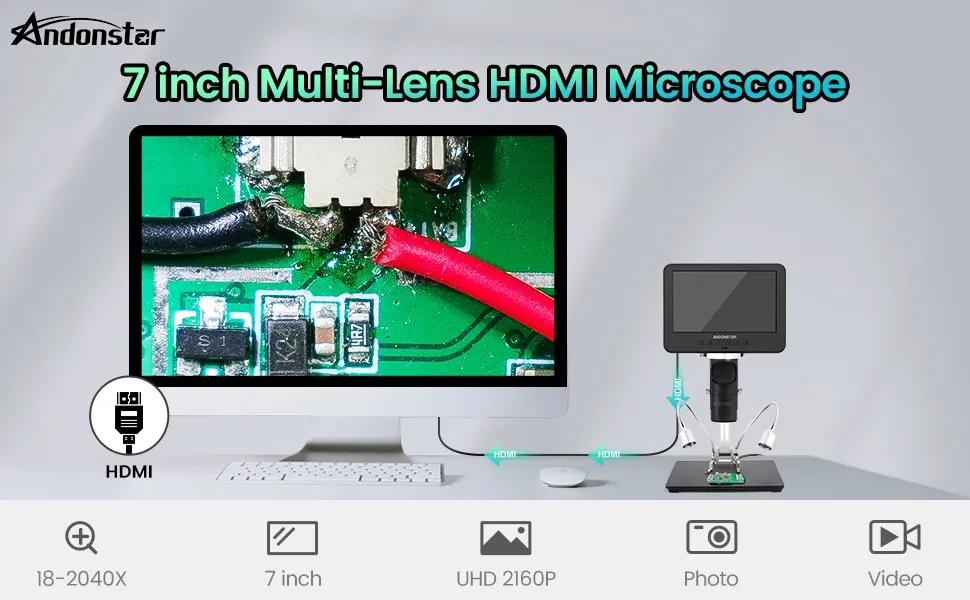
At £164.15, the Andonstar AD246S-M hits a sweet spot that's hard to argue with. It's a professional digital microscope with a 7-inch integrated display designed specifically for electronics repair, micro-soldering, and mobile phone board work. No laptop needed — just plug in and go.

I've had one on my bench since early this year. The screen clarity is spot on for identifying cold joints and bridged pins on 0402 components. Working distance gives you enough room to get a soldering iron underneath without bumping the lens housing. Is it perfect? The stand could be heavier — I ended up bolting mine to the bench after it shifted during a tricky rework session. That said, for the money, nothing else comes close in the UK market right now.

Key specs: 2000x digital magnification, adjustable LED ring light, HDMI output option, SD card recording for documentation. If you're doing warranty work or need to photograph board damage for insurance claims, the recording function is dead useful.

Tomlov DM602 Pro

Tomlov's stepped up their game this year. The DM602 Pro runs about £180–£210 and offers a 10.1-inch screen — larger than the Andonstar, which some techs prefer. Magnification range is 50x–1300x optical with digital zoom beyond that. The coin-inspection crowd love these, but they're genuinely capable for soldering work too.

The larger screen is nice but makes the unit bulkier. If bench space is tight — and let's be honest, whose isn't — the Andonstar's 7-inch form factor might suit better.

AmScope and Mid-Range Alternatives

AmScope's Full HD 7-inch compound digital microscope (around £300–£400) bridges the gap between bench scopes and lab instruments. It includes a mechanical stage and four objectives, making it more suited to biological or materials science work than soldering. Worth considering if you need versatility across different inspection tasks.

Professional bench scope price range (UK, 2026): £130–£450 | Typical magnification: 50x–2000x | Best for: Micro soldering, PCB inspection, component-level repair

Portable, Handheld, and Educational Digital Microscopes

Versatile digital microscope suitable for educational and portable field work

Sometimes you need to inspect something that won't fit on a bench. Or you're teaching a class. Or you just want a quick look at a suspect solder joint without firing up the main scope. Handheld USB microscopes fill that gap nicely.

Celestron Digital Microscopes

Celestron's handheld models (the 44302-C and similar) run £40–£80 and offer 20x–200x magnification via USB connection. Build quality is decent — proper optics from a company that knows lenses. They're popular in UK schools and colleges for STEM teaching. Not suitable for precision soldering work, but brilliant for surface inspection, entomology, or quick QC checks on incoming components.

Jiusion USB Microscopes

At £20–£35, Jiusion's USB scopes are the budget entry point. 40x–1000x claimed magnification (take the upper figure with a pinch of salt — they always do this). They work with Windows, Mac, and Android via OTG. My mate uses one for checking watch movements and swears by it for the price. For anything requiring measurement accuracy or consistent lighting, you'll want to step up. But as a "chuck it in the toolbag" option? Sorted.

Levenhuk DTX 500 Mobi

The Levenhuk DTX 500 Mobi (around £90–£110) deserves a mention. It's a standalone handheld unit with its own 3.5-inch LCD — no computer required. 20x–500x magnification, built-in measurement software, and a rechargeable battery. Proper portable inspection for field engineers who need to document defects on-site.

If you're using inspection equipment in workplace settings, the Health and Safety Executive (HSE) provides guidance on display screen equipment regulations that apply when technicians spend extended periods using microscope displays.

Digital Microscope UK Comparison: 2026 Specs and Pricing

Here's how the main contenders stack up across the categories that matter most for UK buyers this year:

Model Price (UK, 2026) Magnification Display Best For Working Distance
Keyence VHX-7000 £30,000–£55,000 20x–6000x External 4K monitor Aerospace QC, failure analysis Variable (lens dependent)
Hirox KH-1300 £25,000–£45,000 1x–7000x External monitor Cross-section analysis, R&D 35mm–150mm
Tagarno PRESTIGE £8,000–£20,000 Up to 300x External HDMI Production line inspection Up to 320mm
Andonstar AD246S-M £164.15 2000x (digital) 7-inch integrated Micro soldering, phone repair ~100mm
Tomlov DM602 Pro £180–£210 50x–1300x 10.1-inch integrated PCB inspection, coin collecting ~110mm
Celestron 44302-C £40–£80 20x–200x USB (computer required) Education, quick inspection 15mm–30mm
Jiusion USB £20–£35 40x–1000x (claimed) USB (computer/phone) Hobby, basic checks 10mm–20mm
Levenhuk DTX 500 Mobi £90–£110 20x–500x 3.5-inch built-in LCD Field inspection, portable use ~20mm

What to Look For: UK Buyer's Checklist for Inspection Microscopes

Choosing the right optical inspection tool depends on your specific workflow. Here's what actually matters — not marketing fluff.

Working Distance

This is the gap between the lens and your workpiece. For soldering, you need at least 80mm to fit an iron tip underneath. The Andonstar AD246S-M gives you roughly 100mm. Industrial systems like Tagarno offer 320mm. USB scopes? Often under 30mm — useless for active rework.

Magnification: Optical vs Digital

Don't get seduced by "2000x" claims. Digital zoom beyond optical capability just enlarges pixels. For micro soldering on 0201 or 0402 components, 30x–50x optical magnification is the practical sweet spot. You need to see the joint clearly, not count atoms. Higher magnification narrows your field of view, which slows you down.

Display Type

Integrated screens mean fewer cables and faster setup. USB-connected scopes give you recording flexibility and larger display options but add clutter. HDMI output is the best compromise for professional setups — run it to whatever monitor suits your bench layout.

Lighting

Adjustable LED ring lights are standard on bench models. Look for variable intensity and ideally segmented control (so you can light from one side to reveal surface texture). Polarised lighting options help reduce glare on shiny solder joints — a real issue when inspecting fresh reflow work.

UK-Specific Considerations

Check the power supply ships with a UK plug or includes an adapter. Sounds obvious, but I've been caught out ordering direct from overseas suppliers. Also verify warranty coverage — Which? consumer guidance confirms your statutory rights under UK consumer law apply regardless of where the seller is based, but enforcing them internationally is another matter entirely.

For professional environments, ensure your chosen microscope meets any sector-specific requirements. Medical device inspection, for instance, may require documented calibration traceable to national standards. The GOV.UK website provides information on product compliance requirements for equipment used in regulated industries.

Minimum working distance for soldering: 80mm | Practical magnification for SMD work: 30x–50x optical | Recommended display size: 7 inches minimum

Frequently Asked Questions

What's the best digital microscope UK buyers can get for micro soldering under £200?

The Andonstar AD246S-M at £164.15 is the strongest option under £200 for micro soldering in the UK. It features a 7-inch integrated display, approximately 100mm working distance for iron clearance, adjustable LED lighting, and SD card recording for documentation. No computer connection required — it's a self-contained bench tool ready for component-level phone and PCB repair.

Are USB digital microscopes good enough for electronics repair?

USB microscopes like the Jiusion (£20–£35) work for inspection and diagnosis but aren't practical for active soldering. Their short working distance (10–30mm) leaves no room for tools underneath. They're best used for pre- and post-repair checks, photographing damage, or educational purposes rather than live rework sessions.

How much magnification do I actually need for PCB inspection?

For most PCB inspection and SMD soldering, 30x–50x optical magnification is the practical range. This lets you clearly see 0402 and 0201 components, identify solder bridges, and check joint quality. Higher magnification (200x+) is useful for failure analysis of specific defects but narrows your field of view too much for active work.

Is a Keyence microscope worth the cost for a small UK repair business?

For most small repair businesses, no. Keyence VHX systems start at £30,000 and are designed for aerospace, automotive, and semiconductor QC where documented, repeatable measurements justify the investment. A professional bench scope like the Andonstar AD246S-M at £164.15 handles 95% of repair shop tasks. Save the Keyence budget for when you're doing certified failure analysis work.

What's the difference between a digital microscope and a stereo microscope for soldering?

A stereo microscope uses dual optical paths to provide depth perception through eyepieces — you look directly through it. A digital microscope captures the image via a sensor and displays it on a screen. Digital models reduce eye strain over long sessions, allow easy recording and sharing, and let multiple people view simultaneously. Stereo scopes offer slightly better depth perception but cause neck strain and can't record without add-on cameras.

Can I use a digital microscope for quality control documentation in the UK?

Yes. Models with SD card or USB recording (like the Andonstar AD246S-M) capture images and video suitable for QC records. For ISO 9001 certified environments, ensure your microscope's measurement capabilities are calibrated and documented. Industrial systems from Keyence and Hirox include built-in measurement software with audit-trail features specifically designed for regulated quality documentation.

Key Takeaways

  • Best value digital microscope UK for micro soldering: The Andonstar AD246S-M at £164.15 offers a 7-inch display, 100mm working distance, and SD recording — no computer needed.
  • Industrial systems (£8,000–£55,000) from Keyence, Hirox, and Tagarno are justified only for aerospace QC, failure analysis, or certified inspection environments.
  • Working distance is critical: You need minimum 80mm clearance for soldering iron access. USB scopes typically offer only 10–30mm — fine for inspection, useless for rework.
  • Practical magnification for SMD work is 30x–50x optical. Ignore inflated "2000x digital" claims — they just enlarge pixels without adding detail.
  • Portable options like the Levenhuk DTX 500 Mobi (£90–£110) serve field engineers who need standalone inspection without a bench setup.
  • Budget USB scopes (Jiusion at £20–£35, Celestron at £40–£80) work for education, hobby use, and quick diagnostic checks but aren't professional soldering tools.
  • For UK buyers in 2026: check power supply compatibility, warranty enforcement, and sector-specific compliance requirements before purchasing.

So what's the right choice? It depends entirely on your workflow and budget. For most repair technicians and electronics enthusiasts across the UK, a mid-range bench scope with an integrated display delivers the best bang for your buck. I'd point anyone doing regular micro soldering toward the Andonstar range as a starting point — proven, affordable, and purpose-built for the job. If you're running a certified QC lab, that's a different conversation entirely, and you'll know it.

Ready to try Andnstrhan?

Shop Now — £257.40